Friday, October 7, 2011

Chicka Chicka Boom Boom


Chicka Chicka Boom Boom by Bill Martin, Jr. and John Archambault is an alphabet book made fun for all ages. The entire alphabet pledges to meet at the top of the coconut tree until Chicka chicka BOOM! BOOM! All 26 letters fall out of the tree. Despite bumps and bruises, the letters don't lose their adventurous spirit. The story ends with the sun setting on the coconut tree and “a” challenging the letters to a race up the coconut tree.

Beginning with the end pages, illustrator Lois Ehlert does an excellent job capturing the child's attention. Each page is filled with bright, playful illustrations seeming to be made by shapes cut from colorful paper. The coconut tree often spans two pages (and even sometimes extends beyond the pages of the book) and a polka-dot border can be found on every page. At the same time, the pictures do not distract from the purpose of the story—to teach the alphabet. The easy-to-read text similarly lends itself to the teaching of the alphabet with each mentioned letter in bold.

A key component of this text is the jovial spirit created by the authors' use of rhyme. Rhyme is a critical component in the child's development of phonological awareness, an understanding of language sounds and patterns. Use of rhyme within this story supports the child's beginning understanding of letter-sound correspondence and also helps children feel connected to the text. Rhyming patterns are often easier for children to recognize and remember so that they may provide the next word in the story.

To watch a video of Chicka Chicka Boom Boom with lyrics and music, click here.

I hope that you enjoy reading Chicka Chicka Boom Boom with your loved ones as much as I enjoyed it as a young child. Happy reading!

Tuesday, October 4, 2011

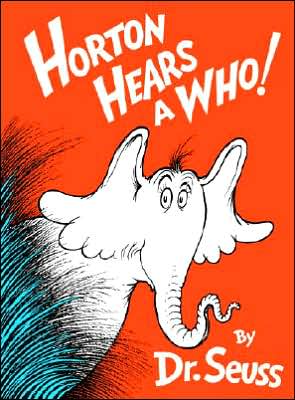
Picture Books From the Past: Horton Hears a Who!


“On the fifteenth of May, in the Jungle of Nool…”


Horton the elephant is just minding his own business when suddenly he hears a cry for help! from a tiny speck of dust. He is shocked to find that a small person is speaking to him. A sour kangaroo scoffs at Horton, not believing that there could ever be a person let alone a whole town living on such a tiny speck of dust. But Horton stands firm and protects his tiny friends from the teasing animals in the Jungle of Nool. One day the other animals can’t stand it any longer that Horton insists on protecting these people he can’t even see. The other animals steal the small speck of dust and Horton will do anything to get it back and save the little town of Whos. Through Horton’s valiant efforts we see that one person really can make a difference.


This classic, children’s picture book from 1954 still manages to
dazzle audiences of all ages. With a dynamic plot and even more dynamic illustrations, Dr. Seuss addresses pivotal issues still relevant in society today. Horton Hears a Who teaches children to value others’ perspectives and to recognize that all people should be treated equally. Horton says it best when he states,


“A person’s a person,

no matter how small.”


Though the illustrations are comprised of only three colors, their dynamic and multidimensional aspects still engage the reader. The timeless rhythm and rhyme of Dr. Seuss’ text carries the reader through the story without imposing on the illustrated narrative. For younger children, this book can be used to subtly familiarize them with time and numbers.


“And at 6:56 the next morning he did it.”


Horton Hears a Who
playfully incorporates differing sizes of text and “zooms” in and out from the Whos’ world to Horton’s to illustrate differing visual perspectives. To see a modern animated film interpretation, look below for the movie trailer directed by Jimmy Hayward and Steve Martino.


Happy Reading!
-Maryphyllis Crean and Jill Dona

Monday, October 3, 2011

Monday's Marvelous Picture Book: Follow Me by Tricia Tusa

Tricia Tusa’s whimsical illustrations in her book Follow Me tell the story of a girl that daydreams about soaring through the sky as she swings on the tree-swing in her backyard. We follow the girl as she leaps off the swing and floats through nature, enjoying the different colors and experiences that each place brings. As the swing falls back down to the ground, the girl’s journey of her imagination brings her back home.

As Tusa intended, Follow me relies heavily on the illustrations to express the concept of exploring the world with the help of your imagination. Tusa explained that she tried to use as few words as possible to convey her message. This intention is made very clear as each page is filled with illustrations, with only a few words of text strategically placed within the images. Although there are only a handful of sentences in the whole book, I think Tusa chose her words wisely. The language that she uses enhances the connection that you make with the story when reading the book.

Now for the most important part: The illustrations! Personally, I love just about every aspect of them. Overall the illustrations are very wispy and playful, and the pastel color palette helps create the sense that this journey is a daydream. Tusa’s depictions of the girl soaring through nature were very creative– the girl looked like she was floating, and even becoming a part of her surroundings.

Tusa has shared some of her early sketches and drawings-in-progress that she created for Follow Me. Below are a couple examples that show her drawing process. If you would like to see more, go to: http://www.amazon.com/Follow-Me-Tricia-Tusa/dp/0547272014

1. "Thumbnail sketches help me to figure out the pacing of a book, and show the book in its entirety revealing how it works as a whole. They make clear the amount of variety from page to page."


2. "I draw with my favorite pencil on tracing paper. I then Xerox these drawings, taping them together into a dummy. This is what I send to the editor."

.


3. "I really wanted this book to have a very imperfect, hand-done quality. So, I decided to use an etching process."

"Swing into a daydream!" with Tusa's amazing book, Follow Me!

Wednesday, September 28, 2011

Picture Books From the Past- Corduroy


Corduroy by Don Freeman has been a well-loved story by children for many, many years. I remember my own mother reading it to me when I was in preschool and have heard it read to children at the preschool I currently work in many times over the past year.

Corduroy is a teddy bear in a big department store. He wears green corduroy overalls, but is missing a button. Therefore, he is often passed over by children looking to buy toys. One day, a little girl walks by with her mother and asks to buy him, but her mother says, “not today.” She comes back the next day to purchase him with her own money saved in her piggy bank, carries him home, sews a new button on his overalls, and gives him his very own bed next to her own. Corduroy is delighted to finally have a home and a true friend.

The illustrations in this book are warm and peaceful. They are watercolor based, use pastel colors, and use a variety of line-based patterns for texture. Here is a preview of the book.

This story describes very nicely the special relationship so many children have with a favorite stuffed animal. Told from the bear’s perspective, children see how important it is to treat their toys nicely. It can also be a source of comfort for children if they are traveling somewhere new. As long as they have their special stuffed toy, they have a friend with them and are not alone.

I hope you and your young reader(s) will enjoy this story as much I have over the years!

~Katharine

A few extra links you may enjoy:

· Here is a read aloud of the story

· If you just can’t get enough of Corduroy, there are many other books based on this loveable bear! Click here for a preview of A Pocket for Corduroy by Don Freeman.

· Corduroy can be used in the classroom as a starting point for many different activities and discussions such as shopping, money, sewing, and friendship. Below are some resources teachers may find helpful in planning:

- coloring page - some lesson ideas


Monday, September 26, 2011


Art and Max by David Wiesner

Looking for a marvelous picture book? Look no further!                                                 
David Wiesner, three-time Caldecott award winner for Tuesday, The Thee Pigs and Flotsum, once again delights children with his picture book, Art and Max. 

“…a thought-provoking exploration of the creative process...Funny, clever, full of revelations to those who look carefully this title represents picture-book making at its best.” —School Library Journal, starred review

The book tells the story of two lizard friends who both enjoy painting. Art is an old pro; Max is just a beginner. When Max misunderstands Art's instruction to "paint him," chaos ensues. Max starts to actually paint his friend! Furious, Art's painted scales then crack off, revealing pastel dust. After the colored pastels blow away, Art is filled in with water colors, which run after he drinks some water. Finally, all that is left of Art is a line drawing. As Art stomps off in a huff, Max grabs his friend, undoing the drawing until he is just a mess of scribbles on the floor. Luckily, Max is able to "reconstruct" his friend, and make him even better than before!

Recommended for ages 4-8, children will love the bright colors, full page spreads, stunning detail and easy to follow story. It would make a good discussion book in the classroom for the topics of art and different media,  the importance of trying new things and friendship. This is the perfect book to share before starting a new art project in the classroom and teachers or parents may like to include computer work by including the online activity, found here, in their lesson.

A video of David Wiesner talking about his book.

I loved looking through and reading this book, and have no doubt that you will enjoy reading and sharing this book just as much. So what are you waiting for...

Happy Reading!

Sunday, September 25, 2011

New Book: Slightly Invisible featuring Charlie and Lola by Lauren Child


“I have this little sister, Lola.

She is small and very funny.


She always wants to know what

I am up to, and she always

wants to do what I am doing.


She NEVER wants to be

anywhere without me.”


Charlie and Marv want to have adventures on their own. They are fed up with Lola interrupting their imaginary play. They want to catch the most STRANGE and terrifyingly tricky creature. Therefore they create an “invisibility potion” made from pink milk, a tiny drop of banana, and a secret INVISIBLE INGREDIENT. While Marv and Charlie sail twice around the world, they leave the potion in the fridge, allowing Lola and Soren Lorensen to drink it. They return from the trip for a snack only to realize that the potion had already been drunk. Lola had a small sip but Soren Lorensen had mUcH moRe. From this point on, Soren is “hidden” on each page. Finding Soren Lorensen becomes a fun and interactive activity, keeping the child engaged throughout the rest of the book. At this point, Charlie and Marv look to Lola and Soren Lorensen to help them find the most STRANGE and terrifyingly tricky creature.

The adventures of Soren Lorensen, Lola, Charlie, and Marv are enhanced through the unique illustration style and moving text. Lauren Child uses a combination of real and drawn pictures through out the book. On one page this could include using different patterns to create the background and object cut outs in the foreground,

while on the next it could be the opposite. Along with the images the text is inserted in a moving format. The reader may actually have to move the book in order to follow the storyline. While this may be frustrating to an adult reader, it adds to the adventurous spirits of Charlie and Lola.

This book appeals to children ages 3-7 through the use of imaginative play, sibling relationships, and visual stimulation. Charlie and Lola came to life in 2001 through Lauren Child’s first book of this series, I Will Never Not Ever Eat a Tomato and Slightly Invisible is her latest edition to this series. It later became a TV series in over 20 countries, maintaining the integrity of Lauren Child's artistic works and stories.

<3 Joy Harris and Deirdre Hartnett

Friday, September 23, 2011

Carol Otis Hurst's FIRST picture book! Rocks In His Head

“Some people collect stamps. Other people collect coins. My father collects rocks.”

This book is based on the true life story of the author Carol Otis Hurst’s father. Ever since he was a child, Carol’s father has been passionate about rocks. He has a constantly growing collection displayed in his house, and always has a couple rocks sitting in his pocket. Although people often keep collections of various things, no one thinks his collection is worth anything, and that his hobby was a waste of time. People always tell him, "You've got rocks in your head!"

However, all of them are proven wrong when his knowledge and passion for rocks earns him a job during the Great Depression working at the Science museum. Slowly but surely, Carol’s father works his way up to becoming the curator of mineralogy.

This book sends a great message about staying true to oneself, and doing things that make you happy. As Carol Otis Hurst states, “Anyone who has ever felt a little out of step with the world will identify with this true story of a man who followed his heart and his passion.” Rocks in His Head is a fantastic read for children around age 5 and up. It is a well-written text intertwining history (The Great Depression) with an intriguing true story and positive life messages. Additionally, the unique, sketch-like illustrations (by James Stevenson) on every page give the reader lots of room to use their imagination and fill in the details. If you are looking for a fun, lighthearted read than Rocks in his Head is your perfect book!